
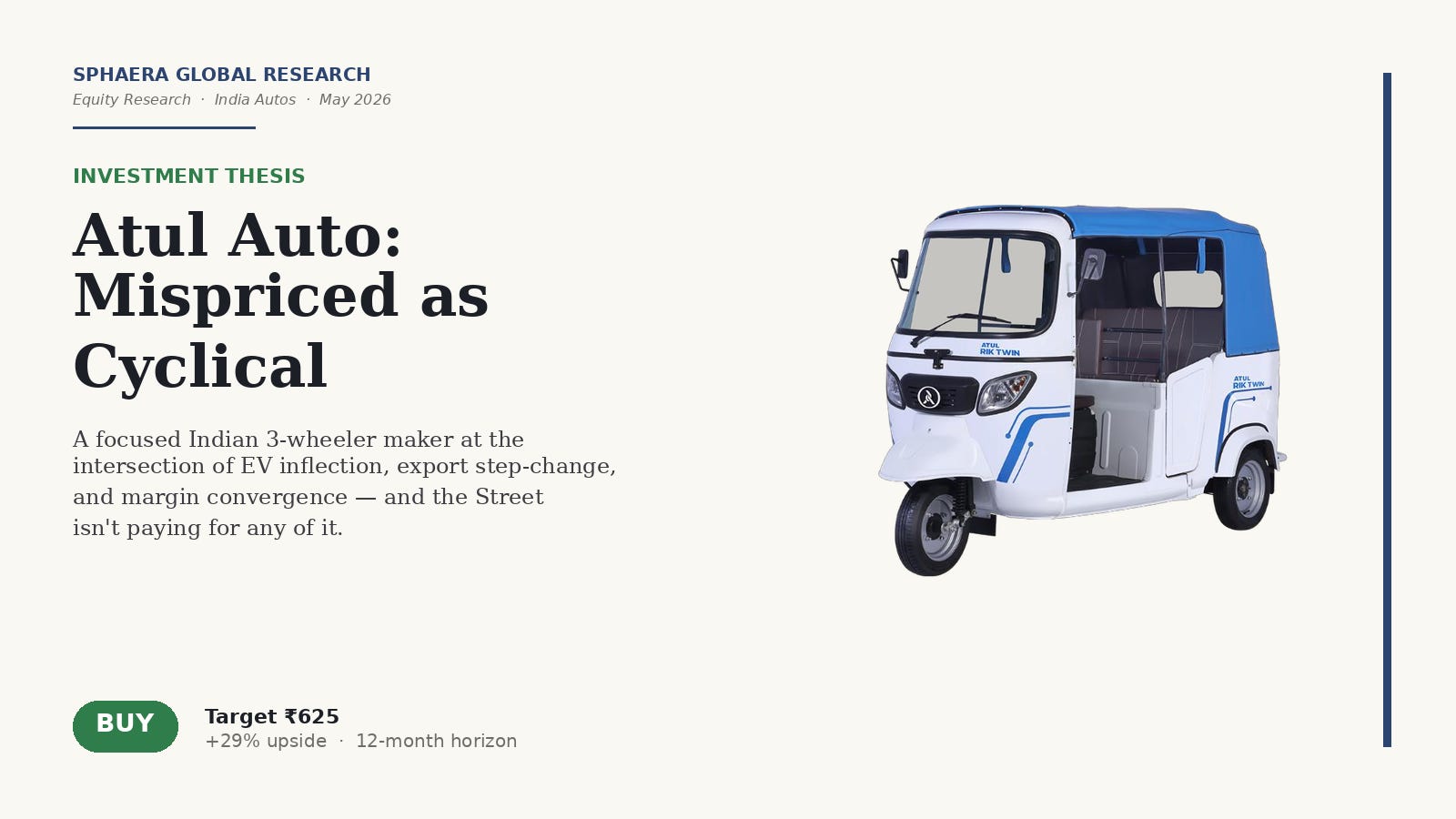
Equity Research Report - Atul Auto: A Mispriced Indian Rickshaw Operator
BUY | Target ₹625 | Upside +29% | 12-month horizon

Sphaera Global Research • India Three-Wheelers • June 2026
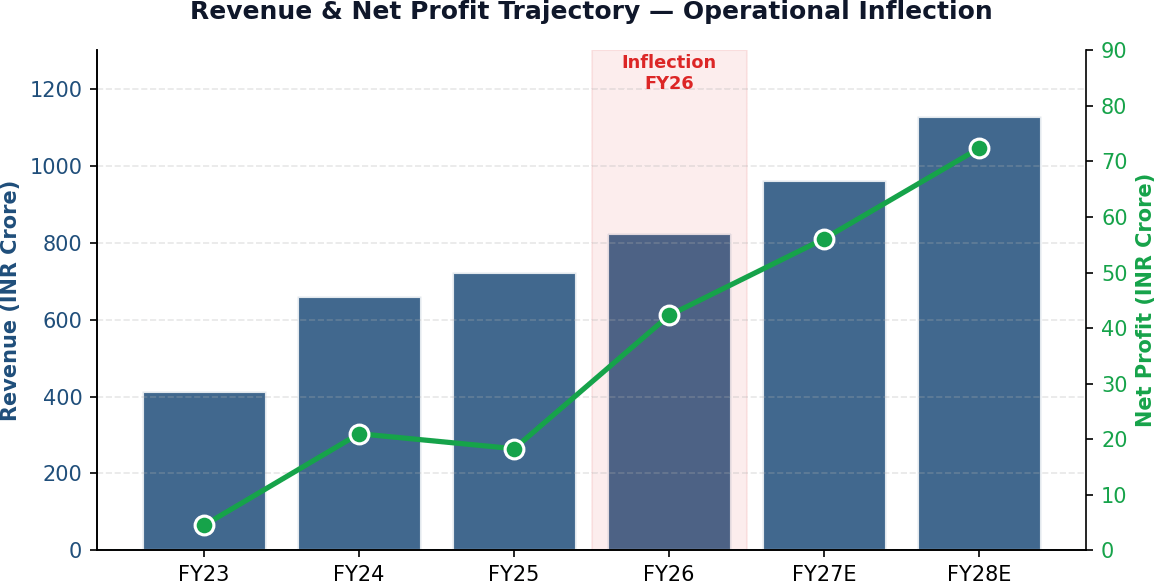
Indian sell-side largely treated Atul Auto’s FY26 print as a cyclical recovery: Revenue up 14%, net profit nearly doubled, EBITDA margins through 11.5%. The footnote read “nice quarter, but…”
I think they’re missing the big break. Per-vehicle EBITDA expanded 49% YoY against volume growth of just 20%, that’s the signature of operational change, not cycle. And underneath the print, three things have changed about this company in the last 18 months. The market is pricing roughly one of them.
What Atul Auto actually is and why three-wheelers matter
For readers who don’t follow Indian commercial vehicles: Atul Auto makes the small three-wheeled cargo and passenger vehicles (”autos” or “tuk-tuks”) that move people and goods through nearly every Indian city and town. Founded in 1986, listed on NSE/BSE since 2013, ~$170M market cap. Single plant in Rajkot, Gujarat with ~60,000 unit annual capacity. Workforce of roughly 575.
The category itself is worth understanding because Indian three-wheelers are the workhorse of last mile commercial mobility for over a billion people, and they sit at a major theme that tracks across Emerging Markets. Roughly 800,000-1M units sell domestically each year, plus exports to Africa, Latin America, and South Asia where similar dynamics apply. The use case is unglamorous but enormous: small-batch goods delivery, intra-city passenger transit, rural-to-town connectivity. A diesel cargo three-wheeler at ₹3-4 lakh is the difference between a small business operator getting his vegetables to market or not.
The Indian market is dominated by Bajaj Auto (~80% domestic share — the category leader by a long way), with Mahindra and Piaggio India as smaller players, and Atul Auto carving out a focused mid-tier niche. Atul’s strategic position is four things: (1) cost-competitive ICE platforms for value-conscious commercial buyers, (2) growing export presence where Bajaj’s pricing premium creates room for share gain, (3) they have a strong foothold in regional markets and rural communities (as these communities develop, they stand to gain), and (4) early-mover positioning in electric three-wheelers via the Atul Greentech subsidiary, now consolidated into the parent.
That last point (the EV transition) is where this break is happening, and it’s worth going deeper on than the bare numbers suggest.
The EV transition: why this isn’t just another e-three-wheeler story
Electric three-wheelers in India aren’t a future story. They’re already 40%+ of new three-wheeler registrations in some categories, supported by FAME II subsidies, state-level incentives, and a structural cost case: electricity is cheap relative to diesel in India, and three-wheeler use cases (predictable urban routes, short daily distances, charging at depot) are unusually well-suited to electrification.1
The challenge for incumbents has been a familiar one. EV unit economics for commercial three-wheelers depend heavily on battery cost, charging infrastructure, and vehicle utilization. A commercial three-wheeler operator needs the vehicle earning money for as many hours per day as possible. Slow charging is the single biggest enemy of EV three-wheeler economics; every hour spent at the charger is an hour of foregone revenue.
This is where the Exponent Energy partnership matters more than the headline suggests.
In April 2026, Atul Auto signed a ₹490.5 Cr commercial contract with Exponent to manufacture 15,000 rapid-charging electric three-wheelers over three years at ~₹3.27 lakh per unit. Three things make this materially different from a typical EV contract:
One: the charging tech is a real differentiator. Exponent’s proprietary battery and charging system delivers 0-100% in under 15 minutes. For context, conventional EV three-wheelers take 3-5 hours for a full charge. A 15-minute charge means a commercial operator can effectively treat the vehicle like an ICE one — top up over a chai break and get back on the road. That single specification meaningfully changes the addressable use cases. Long-distance cargo runs, multi-shift passenger operations, dense urban delivery routes — all become viable EV use cases at 15-minute charging that weren’t at 4-hour charging.
Two: it locks in roughly 13% of annual volume at premium ASPs for three years. The ₹3.27 lakh price point sits ~50% above ICE averages, meaning revenue visibility of ~₹163 Cr annually at richer mix.
Three: it de-risks the EV operating model. Atul absorbed the L5 EV division from subsidiary Atul Greentech in January 2026, pulling EV economics directly into the parent’s financials. That consolidation matters because it removes a layer of opacity and tells you the company is committed to scaling EV inside the core business, not segregating it.
What the market is missing: this isn’t a single contract. It’s Atul Auto positioning itself as the manufacturing partner of choice for rapid-charging EV three-wheelers in India, a category that didn’t really exist 18 months ago, and where Bajaj (the 800-pound gorilla) has been slow to move because of cannibalization concerns on their massive ICE installed base. Atul has less to cannibalize and more to win.
Exports: the cleanest variant view
Domestic EV policy in India is real but volatile. FAME III rules have shifted multiple times, state subsidies vary, and any abrupt change can compress unit economics overnight. The cleanest hedge against that risk is exports, and the data here is what gets me most excited.
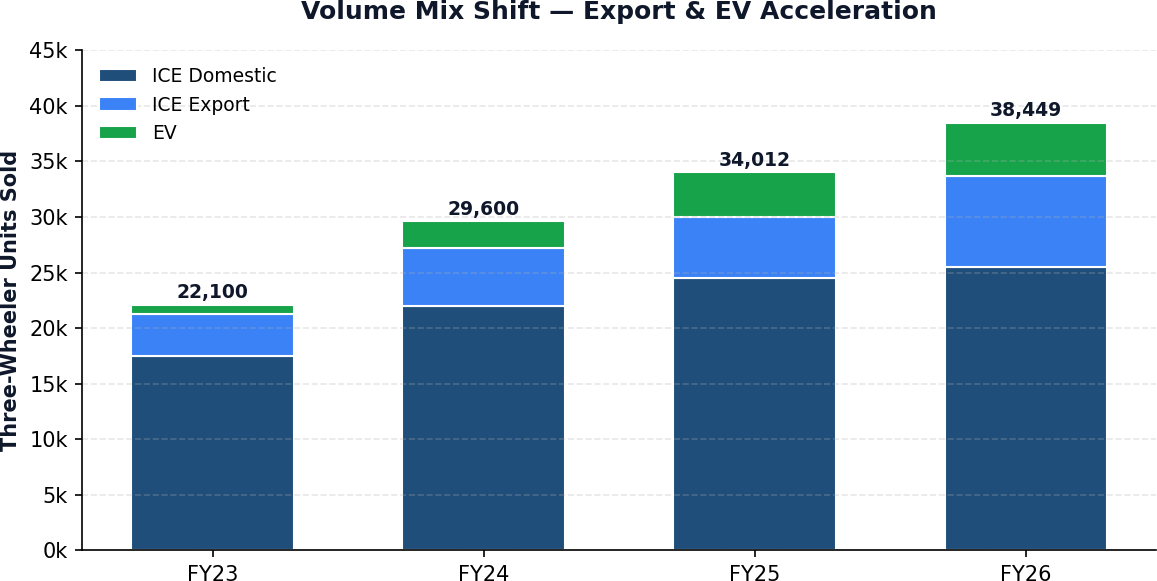
March 2026 export volumes hit 808 units versus a historical run-rate of ~300 — a +167% jump. April 2026 total volumes were +74% YoY, with domestic ICE +98.6% and EVs +28%. That’s not incremental growth. It’s a step-change.
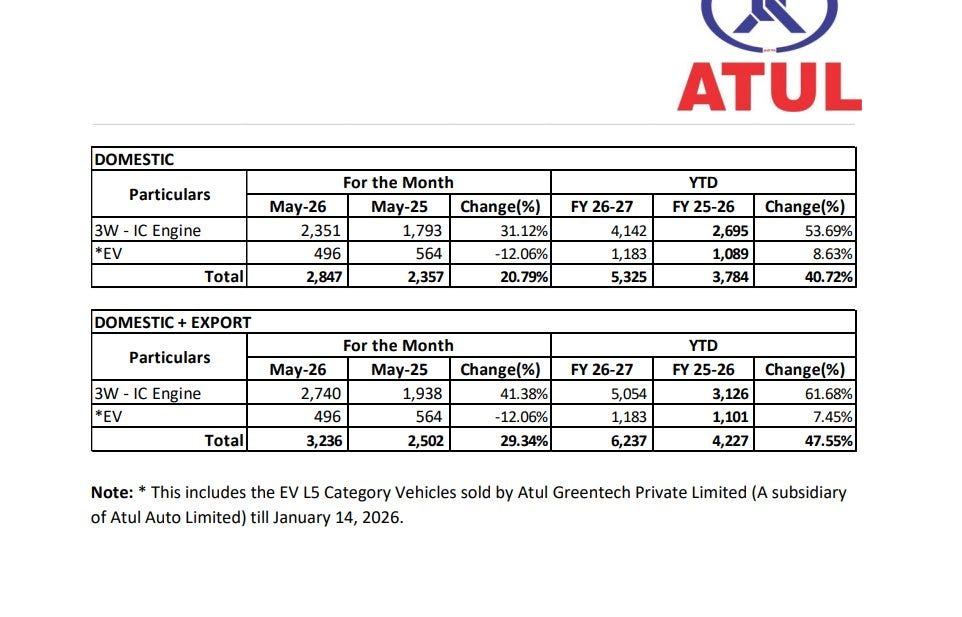
The logic: Latin American, African, and South Asian commercial transport markets remain heavily ICE-dependent and price-sensitive. Bajaj’s pricing premium has been creating share opportunity in these markets for years, and Atul is finally capitalizing. Export ASPs run 15-20% above domestic and carry 200-300 bps of structural margin premium. The export book is now significant enough to insulate Atul from short-term Indian EV policy disruption while the domestic EV mix continues to scale.
For Substack readers tracking EM commercial mobility electrification: this is interesting because Atul is straddling both sides of the transition. Domestic India increasingly electric, supported by infrastructure and policy. Export markets still heavily ICE, where Atul’s cost-competitive platforms have natural advantage. Two engines, both currently accelerating.
Captive financing: the asset the market won’t credit
Atul Financial Services, the company’s Non-Bank Financial Company subsidiary generated ₹52.4 Cr revenue in FY26, up 17.7% YoY, with ₹11.8 Cr segment profit. In a sum-of-the-parts, this barely moves the needle. But in the operating model, it’s important.
In the Indian three-wheeler cargo segment, small commercial operators almost always need financing to take delivery. A captive NBFC removes friction at the dealership level, supports unit economics through the cycle, and reduces working capital strain on dealers. It also scales linearly with vehicle volume meaning the operating leverage in the parent’s auto business compounds alongside a financing arm that grows with it. Captive finance is precisely the kind of asset Indian small-cap analysts reliably under-credit.
Quick Finances:
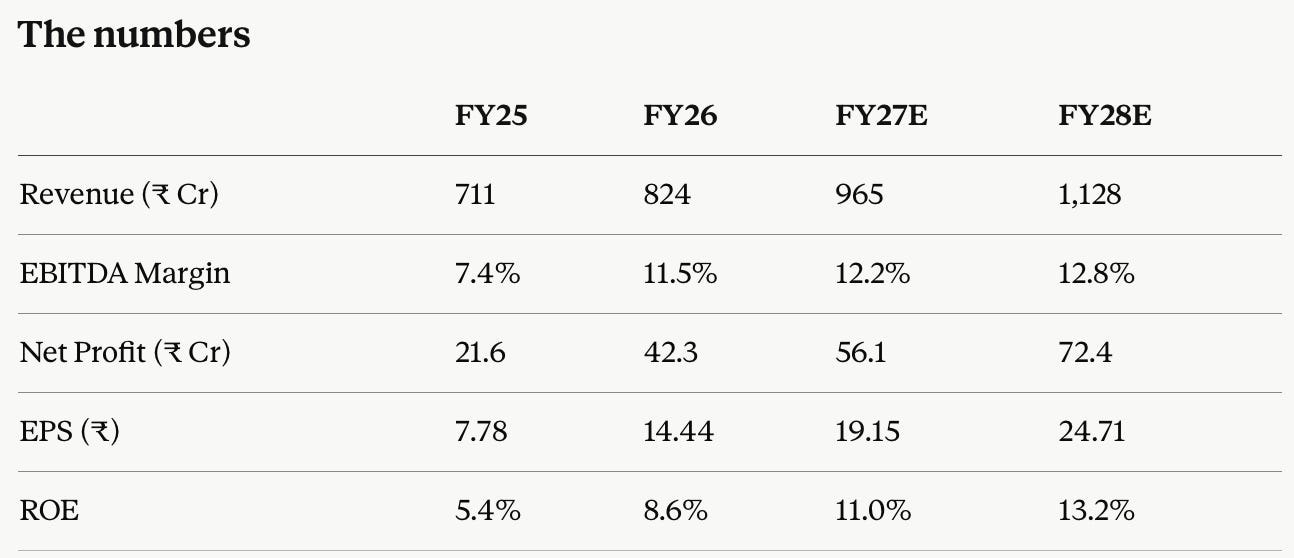
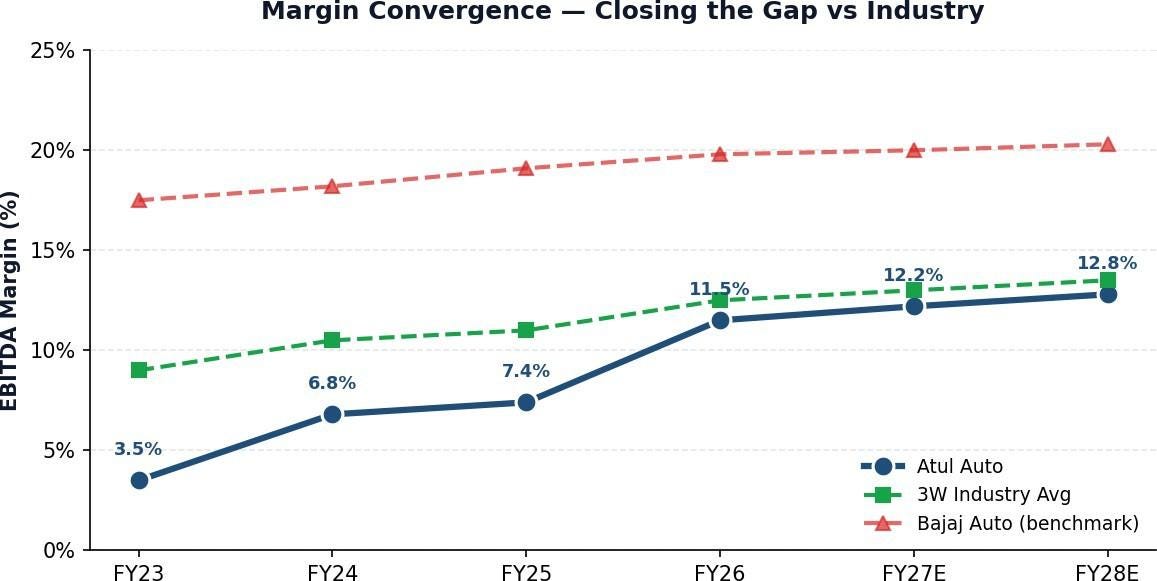
The key driver going forward is margin convergence. Atul has historically run 5-10 percentage points below the broader three-wheeler industry average and 15+ points below Bajaj. FY26 was the first year that gap closed materially — 11.5% margin against an estimated industry average of 12.5%. By FY28, I expect convergence to industry levels as EV mix scales and exports carry their structural premium.
The Bajaj gap won’t fully close. Bajaj has scale, brand, and a distribution moat that justifies a structural premium. But the industry-average gap should and that’s enough for the thesis.
Valuation: ₹625 from two methods that agree
I triangulate fair value two ways.
DCF with WACC of 12.5% (India equity risk premium ~7%, risk-free 6.8%, beta 0.95) and terminal growth of 4.5%, consistent with long-run Indian commercial vehicle demand. Capex/sales of 4% reflecting ongoing EV powertrain investment. Yields enterprise value of ~₹1,710 Cr, equity value ~₹1,840 Cr after net cash, implying ₹630 per share.
Target P/E of 25x applied to FY28E EPS of ₹24.71 gives ₹618 per share. The 25x is a justified premium to Atul’s historical 18x mean given (a) structural margin improvement, (b) higher-quality earnings mix from EV and exports, and (c) reduced earnings volatility from the captive NBFC. Sits at a 15-20% discount to Bajaj’s typical 30x forward multiple, appropriate for the scale gap.
Blended target: ₹625, implying 29% upside on 12 months.
The DCF is most sensitive to WACC. At 13.5% WACC and 4.5% terminal growth, fair value compresses to ₹565 — still 17% upside. At 11.5% WACC and 5% terminal, you get to ₹745. The asymmetry favors the long.
What would make me wrong
Five risks I’m watching:
Bajaj responds aggressively. Bajaj at 80% share has the firepower to compress Atul’s margins faster than my model assumes if it chooses to. The Exponent contract provides insulation in the rapid-charge EV niche but doesn’t eliminate domestic competitive pressure across the broader ICE and standard-EV book. This is the risk I worry about most because they are so well capitalized.
FAME III or state EV subsidies get cut. My base case assumes continued government support. A meaningful pullback could shave 5-8% off fair value. The export book hedges this partially but not fully. I don’t see this likely to happen, and believe Iran War shocks have placed focus for India further on renewables, could see even more subsidies going forward.
Export concentration. The export jump is real but runs through a handful of distributors. Loss of a single major relationship could materially impact volumes. I’d want to see the distributor list diversify over the next four to six quarters.
Raw material pressure. ABS resin pricing was up ~14.5% recently. Atul has historically passed through, but with a 1-2 quarter lag, meaning quarterly margin volatility could be coming.
Exponent execution. The ₹490 Cr contract is binding but requires Atul to deliver 15,000 units over three years. Production ramp issues, supply chain disruption, or battery integration problems could push revenue recognition out.
The setup
What you have is a focused micro-cap with binding EV revenue visibility, an export business changing in real time, a captive NBFC the market doesn’t credit, and institutional ownership under 1% meaning real room for re-rating if any of the structural points become consensus.
The market is treating FY26 as a print. I think it’s an inflection. ₹625 target, BUY, 12-month horizon. Stop loss at ₹395 (-18.5%) for risk management.
For readers tracking the broader theme: Atul Auto is one of the most interesting cleantech-adjacent EM names available right now. Not because it’s a glamour EV story, it really isn’t. But because it sits at the intersection of three real, measurable trends: the electrification of Indian last-mile logistics, the export arbitrage opening as category leaders price too high, and the structural improvement of a previously sub-scale operator getting its margin act together. Setups like this rarely stay mispriced for long.
This report is for informational purposes only and does not constitute personal investment advice. All figures sourced from company filings, exchange disclosures, and public press releases. Forecasts are estimates and may differ materially from actual outcomes. The author holds no equity interest in Atul Auto Limited at the time of publication. Past performance is not indicative of future results.
Fame II is an Indian regulation beginning in 2019 that lays out funding and incentives for EVs across the country.